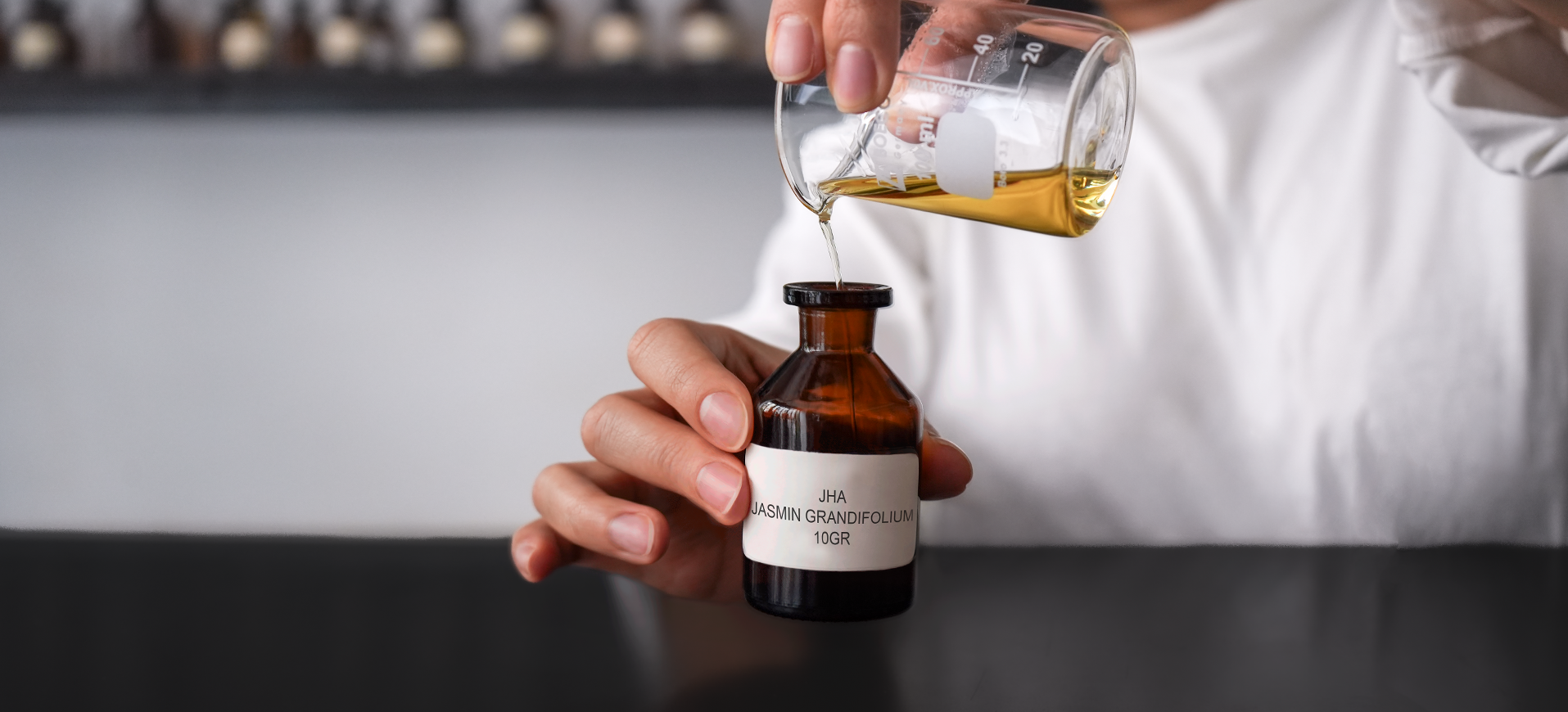
Grandiflorum or Sambac? Natural or synthetic? We break down what jasmine really is in fine fragrance — and why it's perfumery's most misunderstood material.
Why Jasmine Is Never Just Jasmine
Jasmine doesn't smell like one thing. Depending on the species, the origin, the harvest season, and the extraction method, it can read as creamy and fruited, deeply animalic, green and tea-like, or radiantly transparent.
This is what we'll break down: two species, three extraction methods, one synthetic revolution, and a handful of perfumes that show exactly what jasmine can do when a perfumer knows what they're holding.
Two Jasmines: Grandiflorum vs Sambac
There are over 200 species of jasmine. In fine perfumery, two matter.
Jasminum Grandiflorum — the historical reference
Cultivated since the 16th century in Grasse, and today grown primarily in Egypt, India, Morocco, and southern France, Grandiflorum is the jasmine of classical perfumery. Its flowers are harvested from June to December, at dawn, by hand — and they begin losing their scent within hours of picking. The yield is brutal: approximately 400 kilograms of fresh blossoms to produce one kilogram of absolute.
The olfactory profile is rich, creamy, and subtly fruited, with an animalic undertow. It's the jasmine that anchors classic floral compositions — dense, narcotic, present.
Jasminum Sambac — the other jasmine
Native to South Asia and cultivated mainly in Tamil Nadu, India, Sambac is the jasmine of temples, weddings, and hair garlands. Only around 10% of the harvest reaches the perfumer — the rest is reserved for religious and ceremonial use. Its season runs from March to September.
Its scent is greener, more indolic, closer to orange blossom. There's a tea-like quality — sometimes described as "clean" and "white." Where Grandiflorum seduces, Sambac unsettles. In the right hands, that's exactly what makes it extraordinary.
Which one is better? Neither. They're different instruments.
How Jasmine Absolute Is Made: Three Methods, Three Profiles
The extraction method isn't just a technicality. It changes what you end up with.
One thing, first: steam distillation is impossible. Heat destroys the key aromatic molecules — indole and jasmone don't survive. Anyone claiming steam-distilled jasmine absolute is selling you something else.
Enfleurage — the historical method
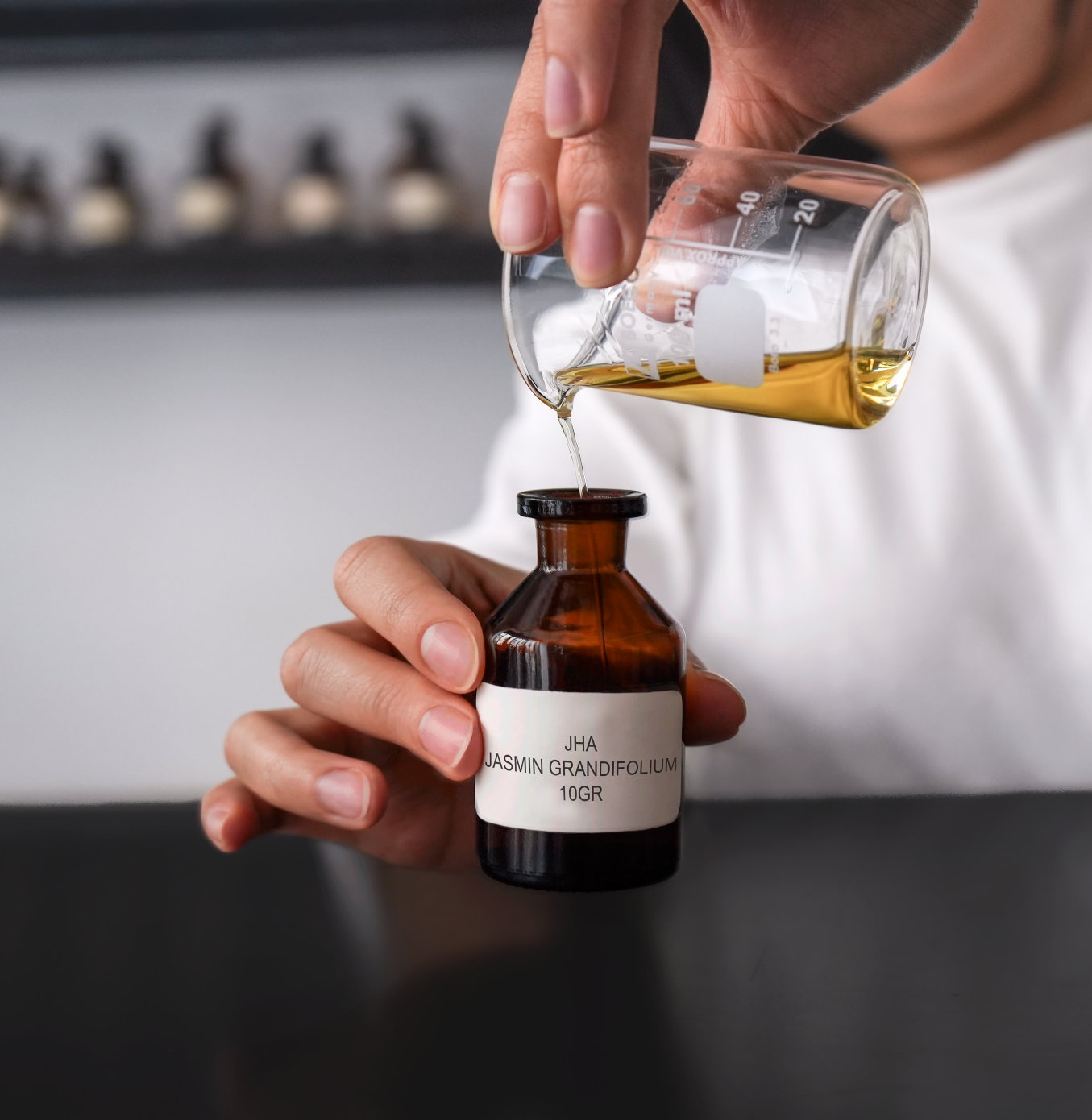
Flowers are laid on glass plates coated in fat, which slowly absorbs their scent over 24 to 48 hours. The process is repeated throughout the flowering season. The fat is then washed with alcohol to recover the absolute. The result is exceptional in quality — and commercially unsustainable. Today, enfleurage exists in small artisan production runs.
Solvent extraction — the current standard
Since the 1940s, this has been the dominant method. Fresh flowers are treated with a hydrocarbon solvent (typically hexane), producing a waxy semi-solid called a "concrete." The concrete is washed with alcohol and chilled to remove plant waxes, yielding the absolute. High quality, scalable. This is what you find in the vast majority of fine fragrances today.
Supercritical CO2 extraction — the contemporary method
More expensive, more precise. CO2 at high pressure acts as a solvent without leaving residue, preserving delicate aromatic molecules that solvent extraction can damage. The olfactory result is closer to the living flower. As the industry moves toward greater traceability, this method is gaining ground.
Why Perfumers Use Synthetic Jasmine — And Why That's Not a Problem
Jasmine absolute — natural, extracted from real flowers — costs between €4,000 and €10,000 per kilogram depending on origin and quality. The synthetic equivalent starts at €50 per kilogram.
That price gap explains part of the story. But only part.
When perfumers talk about "synthetic jasmine," they're rarely talking about one molecule. In practice, the palette breaks into three families — each doing something distinct.
Fresh and airy jasmine — Hedione, Hedione HC, Paradisone
These molecules don't replicate jasmine — they reconstruct its radiance. Light, transparent, diffusive. Hedione (methyl dihydrojasmonate), first used by Edmond Roudnitska in Dior's Eau Sauvage in 1966, created a quality of freshness that the natural absolute cannot produce. Perfumers don't reach for it when they want jasmine. They reach for it when they want air.
Natural and floral jasmine — Cis-jasmone, Benzyl acetate, Linalool
These are the structural molecules found in the natural absolute itself. Used in isolation or in reconstruction, they build what most people recognise as "classic jasmine" — warm, round, clearly floral. When a perfumer wants the reference, these are the tools.
Sensual and narcotic jasmine — Indole, animal and lactonic molecules
This is where jasmine becomes something else entirely. Indole at low doses reads as white floral; pushed further, it turns animalic, almost unsettling. This is the register that makes certain jasmine fragrances polarising — and fascinating. It's also the facet closest to what Grandiflorum absolute smells like when extracted at peak quality.
The question a perfumer asks is never "natural or synthetic?" It's: which register does this formula need?
Five Jasmine Perfumes Worth Knowing
Understanding the material is one thing. Smelling it on skin is another. Here are five fragrances — each showing a different dimension of jasmine, from the most classical to the most radically transformed.
FLEUR NARCOTIQUE — Ex Nihilo
The name says it plainly. Fleur Narcotique is built around jasmine Grandiflorum absolute pushed to its most animalic, indolic register — warm skin, dense floral, something almost unsettling. This is jasmine as a perfumer's raw material, not as a decorative note. If you've only encountered jasmine in its polite form, this will change your reference point.
JASMINE HAZE — Reservation
Jasmine Sambac in its green, tea-like register. Where Fleur Narcotique amplifies the animalic facet, Jasmine Haze pulls in the opposite direction — fresher, greener, closer to the actual flower as it's worn in Indian hair garlands. The indolic edge is there, but softened. This is sambac as it smells at dawn, before the sun comes up.
WOOD & ABSINTH — Mark Buxton
An unusual context for jasmine: dry, woody, bitter. The Grandiflorum absolute here plays against absinthe and woody notes in a way that pulls out its animalic facet without letting it dominate. It's a masterclass in using jasmine as structure rather than as star. For a customer who thinks they don't like jasmine — this is where to start.
Every jasmine perfume in our selection has been chosen and certified by our olfactory experts. Explore our jasmine edit — and if you're not sure where to start, our quiz will tell you exactly which facet is yours.