Most perfumes are stored wrong. Not because of neglect — because no one explains the actual science. Here's what changes everything.
Why Storage Matters More Than You Think
A fragrance is a chemical composition. And like any chemical composition, it reacts to its environment.
Heat accelerates oxidation. UV light breaks molecular bonds. Humidity introduces moisture that reacts with fragrance compounds. Air exposure — every time you spray — brings oxygen into the bottle, slowly altering what's inside.
None of this is dramatic. It's gradual, invisible, and entirely preventable once you understand what's actually happening.
The good news: proper storage doesn't require special equipment. It requires understanding three factors — and changing a few habits that most people don't even know are a problem.
Temperature: The Most Damaging Factor
Heat is the dominant factor in fragrance degradation — and the most actionable one.
Most of the mechanisms that alter a perfume over time — oxidation, hydrolysis, isomerisation, polymerisation of certain aromatic molecules — are accelerated by temperature. The notes that suffer first are typically citrus (limonene, bergamotene), certain aldehydes, and natural materials rich in terpenes. What you observe: loss of freshness, yellowing of the liquid, disappearance of top notes, a heavier or more resinous character in what remains.
A useful rule of thumb: for every 10°C increase in temperature, chemical reaction rates roughly double. This is an approximation — some reactions increase by 1.5×, others by 3× or more — but it gives a sense of scale. A bottle stored at 30°C doesn't age twice as fast as one at 20°C to the exact decimal. It ages significantly faster. That's what matters practically.
Stability matters as much as temperature itself. A perfume kept consistently at 24°C will generally fare better than one oscillating daily between 15°C and 35°C. Temperature swings cause the liquid and the air inside the bottle to expand and contract, increasing oxygen exchange and stressing sensitive molecules.
Where this goes wrong most often:
— In a car (interiors can reach 50–70°C in summer — a few weeks can be enough to alter a fragrance noticeably)
— On a windowsill or near a radiator
— In a small, poorly ventilated bathroom that swings between 20°C and 35°C with heavy steam daily
Light: The Silent Degrader
UV light — and, to a lesser extent, high-intensity visible light — degrades fragrance through photo-oxidation and photo-isomerisation, breaking down certain aromatic molecules. The ingredients most sensitive to this are natural materials rich in terpenes: bergamot, lemon, orange, grapefruit, petitgrain.
What you observe when light has done its work: loss of freshness, fading of citrus brightness, disappearance of green facets, and a progressive imbalance between the opening and the base. The fragrance doesn't necessarily "turn" — it becomes flatter, less nuanced. The danger isn't a few minutes of exposure during use. It's cumulative exposure: a dressing table facing a window, a sunlit shelf, a display case in a bright room. Hours accumulate over weeks.
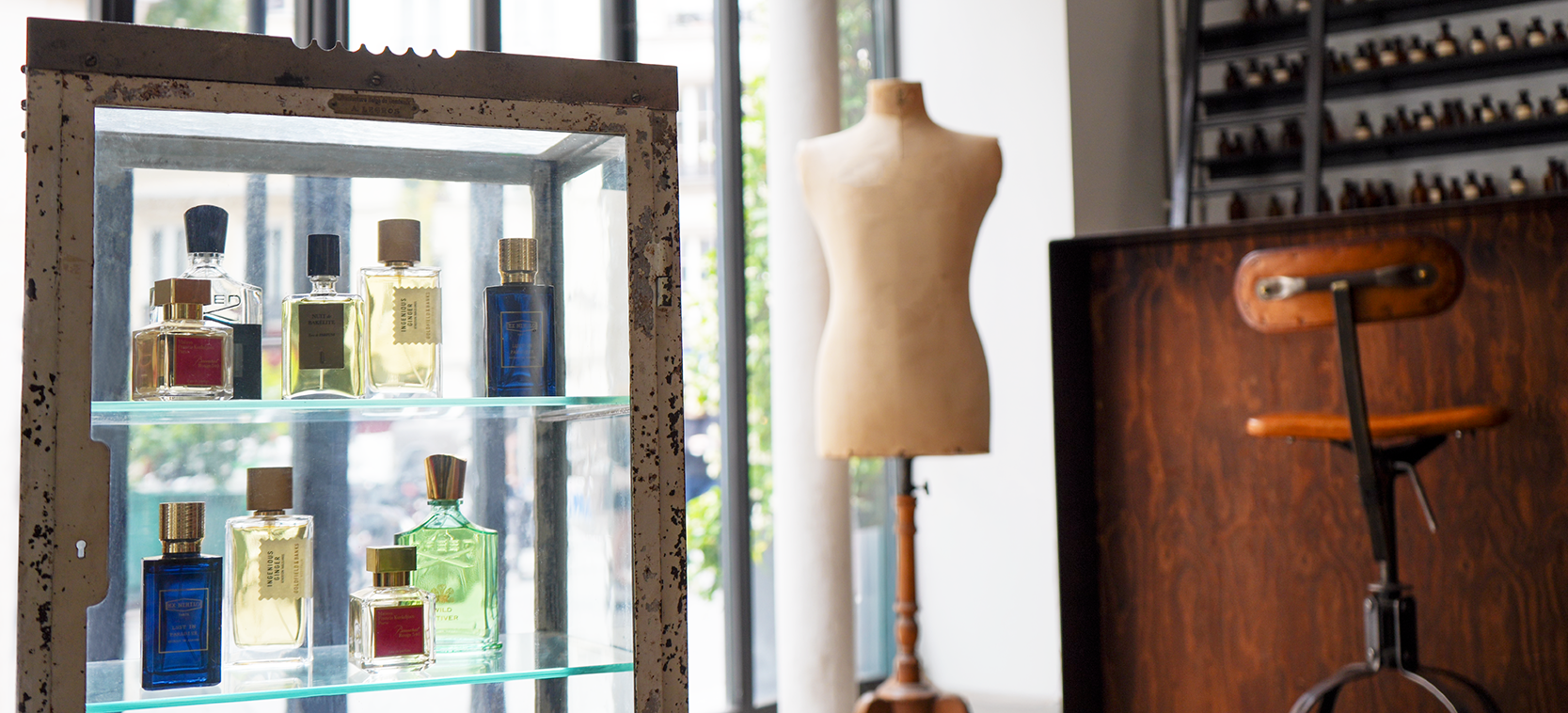
On bottle colour: tinted and opaque glass does offer more protection than clear glass — amber and dark glass absorb more UV, fully opaque materials the most. But the type of glass matters too; some clear glass already filters a portion of UV, so the protection gap between clear and tinted varies. The more reliable variable is simply exposure itself: a clear bottle kept in a drawer is safer than a tinted bottle on a sunny windowsill..
Humidity and Air: Two Quieter Threats
Humidity
Moisture in the air doesn't enter a well-sealed bottle easily — but it works on the seal itself, and on the liquid when the bottle is open. The ideal relative humidity for fragrance storage is between 40% and 60%. Bathrooms frequently hit 70–90% during showers, which makes them a poor storage choice for fragrances used infrequently or kept long-term.
Signs that humidity has already done damage: clouding of the liquid, sediment forming at the bottom, or a faintly sour undertone in the opening.
Air exposure
The most scientifically solid point in this section is also the simplest: as the liquid level drops, the volume of air inside the bottle increases — meaning more oxygen is available to react with fragrance molecules. This is particularly visible on citrus notes, certain green aromatics, and natural materials. A near-empty bottle of something precious is more vulnerable than a full one.
In practice, though, the contribution of each individual spray is modest. Modern atomisers significantly limit air exchange with the outside. Over the lifetime of a bottle used normally, temperature and light exposure typically have more impact than the air introduced at each application.
Replacing the cap after use is a reasonable habit — but on most modern bottles, the main seal is at the pump and the crimp, not the cap. The cap is primarily protective and aesthetic. It's worth doing; it's not a critical conservation measure.
One useful practice among vintage fragrance collectors is to transfer the remaining liquid from a nearly empty bottle into a smaller, high-quality airtight atomiser. By reducing the amount of air in contact with the fragrance, this may help limit oxidation during long-term storage. While the benefits will vary depending on the fragrance and storage conditions, the approach can be worthwhile for rare, discontinued, or vintage bottles. If you choose to do so, use a perfectly clean atomiser with a reliable seal and minimise the fragrance's exposure to air during the transfer.