
In 2012, Nose revolutionized the beauty industry with the very first olfactive diagnosis.
This groundbreaking method, developed with master perfumers who reconstructed over 12,000 perfume formulas dating back to the 19th century, and enhanced by AI, remains unmatched, helping you discover your perfect fragrance.
Based on the last 3 perfumes you have worn (up to 10), we can create your olfactive profile, identify key fragrance families and notes, and recommend five perfumes to test with our sample kit.

How to make My Diagnosis?
1 - Create your profile
*Optional – Expert Diagnosis:
Refine your selection by novelty, season, style, or occasion (see glossary below for definitions).
2. Enter up to 10 perfumes you have worn
3. Get your olfactory profile
4. Discover your five recommended perfumes
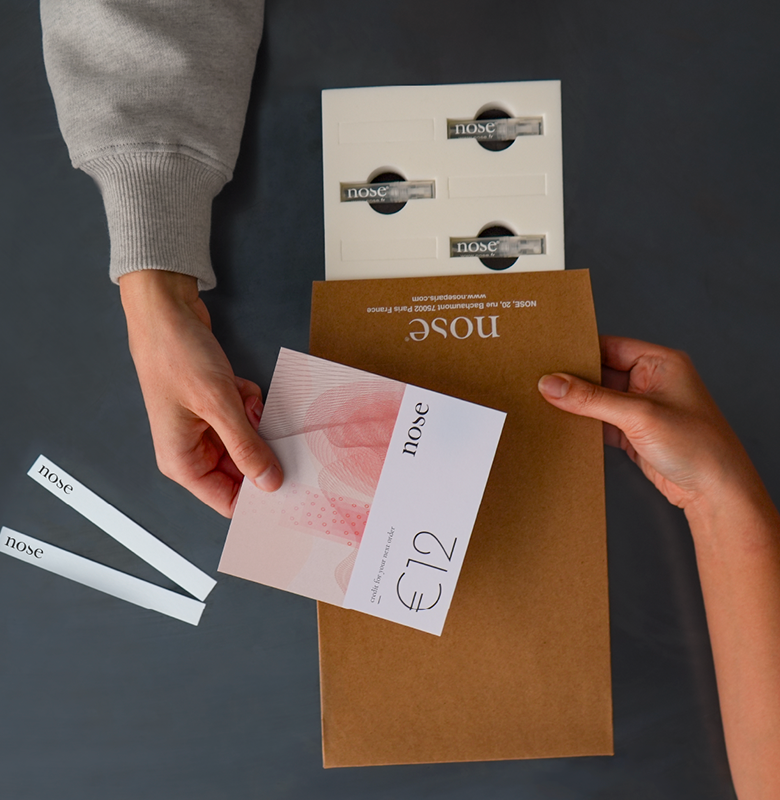
5. Order your sample kit
After testing your perfumes, rate them to get new recommendations or use your €12 voucher on your first full-size order (excluding samples or kits).
*Expert Diagnosis Glossary
spring perfume:
Perfumes with floral notes, called: "white" (lily of the valley, jasmine, mimosa), "sunny/orange" (orange blossom, neroli), "rosy" (rose, hyacinth), or "powdery" (iris, violet), accompanied by fresh and green touches, evoking grass, fresh leaves, or flower stems.
summer perfume:
Fresh perfumes known as "citrus," reminiscent of citrus fruits, with fresh, fruity, and zesty notes (bergamot, lemon, grapefruit), creating a "cologne effect." There may also be a sub-family, a specifier, and/or primary fruity (fig, mango, exotic fruits), milky (coconut), or green (freshly cut grass) notes.
autumn perfume:
Perfumes with woody notes (a combination of woods such as cedar, vetiver, sandalwood) or chypre notes (woody notes, patchouli, and moss). The first can be smoky (birch, guaiac), dry (cypress), or animalic (leathery/tobacco-like). Chypre fragrances, on the other hand, are accompanied by spicy (cardamom, saffron) or green notes.
winter perfume:
Can be identified in two different olfactory families: oriental (ambery) or floriental. The first is a combination of vanilla and patchouli, while the second does not contain patchouli. A winter perfume may also belong to a sub-family, have a specifier, and/or feature primary notes classified as balsamic (incense, tonka), gourmand and sweet (caramel, honey, almond).